Category Archives: electron transfer

Computational Study of Heme b595 to Heme d Electron Transfer in E. coli Cytochrome bd-I Oxidase

Raaif Siddeeque, Baptiste Etcheverry, Côme Cattin, Jean Deviers, Frédéric Melin, Petra Hellwig, Fabien Cailliez, Aurélien de la Lande. J. Chem. Inform. Mod. 2026, in press. Link to Biorxiv

Cytochrome bd is a distinctive family of terminal oxidases present in the respiratory chains of many prokaryotes. Despite their biological importance, the redox chemistry of these proteins remains poorly understood, largely due to the presence of two b-type hemes and one d-type heme. Here, we report the first computational study of interheme electron transfer in the cytochrome bd family. We performed 10 μs of molecular dynamics simulations of E. coli cytochrome bd-I embedded in realistic membranes, combined with quantum chemical calculations to estimate the thermodynamic parameters of electron transfer from heme b595 to heme d within the framework of Marcus theory. We further identify the respective contributions of the hemes, protein scaffold, lipid bilayer, water, and counterions to the driving force and reorganization energy. The interheme electronic coupling was calculated using the Projected Orbital Diabatization (POD) method in a hybrid Quantum Mechanics/Molecular Mechanics scheme and rationalized through electron transfer pathway analysis. This study provides fundamental insights into how electron transfer steps are orchestrated in the catalytic cycle of E. coli cytochrome bd-I.
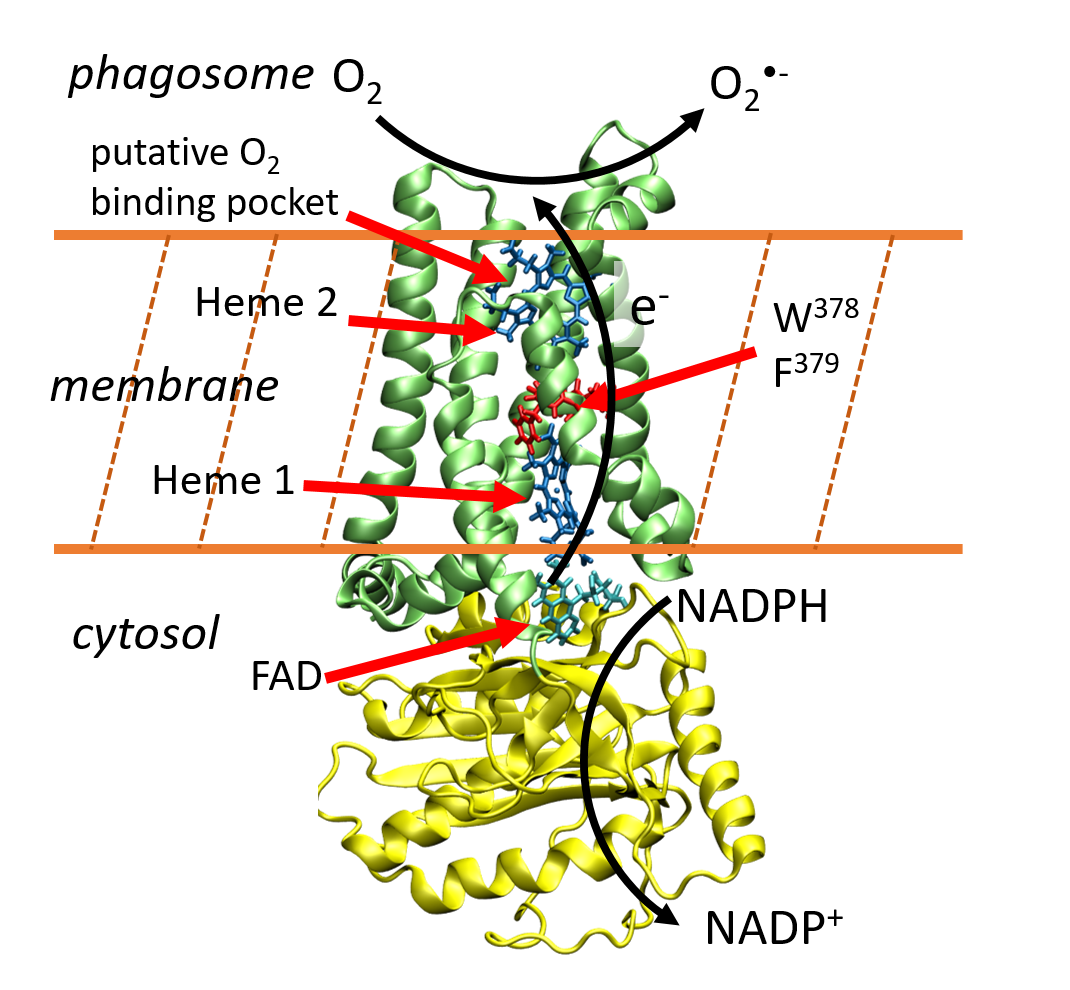
NOX transmembrane electron transfer is governed by a subtly balanced, self-adjusting charge distribution

Baptiste Etcheverry, Marc baaden, Aurélien de la Lande, Fabien Cailliez, under review. Link to BioXxiv

NADPH oxidases (NOX) form a family of transmembrane enzymes that catalyze the formation of reactive oxygen species. These are produced thanks to a chain of electron transfers (ET), shuttling electrons from one side of the membrane to the other, using one flavin and two heme cofactors as redox mediators. In this work we investigate the thermodynamics of the electron transfer (ET) between the two hemes contained in the transmembrane domain by means of extensive molecular dynamics simulations. We compare two proteins of the NOX5 isoform, from homo sapiens (hNOX5) and from cylindrospermum stagnale (csNOX5), a cyanobacteria. We study in detail the influence of both the density of negatively charged lipids in the membrane and of the NOX5 aminoacid sequence on the ET thermodynamic balance. The linear response formalism allows us to decompose the variation in free energy into the individual contributions of the system components (protein, membrane, solvent, etc.). We highlight the major compensatory effects of the various components in the global free energy budget in those complex systems. Although the contributions of the protein or the membrane to the ET thermodynamics can be individually strongly modified by a change in the aminoacid sequence or the membrane composition, they are largely compensated by the rest of the heme environment so that the total free energy is always found to be slightly favorable to the electron transfer. To our knowledge, this study is the first to highlight the effect of membrane charge density on inter-heme ET, providing valuable insights into the molecular mechanisms governing ET catalysis in complex membrane systems.

Mechanistic insights on heme-to-heme transmembrane electron transfer within NADPH oxydases from atomistic simulations

X. Wu, J. Hénin, L. Baciou, M. Baaden, F. Cailliez, A. de La Lande. Frontiers in Chemistry, 2021, 9. doi.org/10.3389/fchem.2021.650651.

NOX5 is a member of the NADPH oxidase family which is dedicated to the production of reactive oxygen species. The molecular mechanisms governing transmembrane electron transfer (ET) that permits to shuttle electrons over the biological membrane have remained elusive for a long time. Using computer simulations, we report conformational dynamics of NOX5 embedded within a realistic membrane environment. We assess the stability of the protein within the membrane and monitor the existence of cavities that could accommodate dioxygen molecules. We investigate the heme-to-heme electron transfer. We find a reaction free energy of a few tenths of eV (ca. −0.3 eV) and a reorganization free energy of around 1.1 eV (0.8 eV after including electrostatic induction corrections). The former indicates thermodynamically favorable ET, while the latter falls in the expected values for transmembrane inter-heme ET. We estimate the electronic coupling to fall in the range of the μeV. We identify electron tunneling pathways showing that not only the W378 residue is playing a central role, but also F348. Finally, we reveal the existence of two connected O2−binding pockets near the outer heme with fast exchange between the two sites on the nanosecond timescale. We show that when the terminal heme is reduced, O2 binds closer to it, affording a more efficient tunneling pathway than when the terminal heme is oxidized, thereby providing an efficient mechanism to catalyze superoxide production in the final step. Overall, our study reveals some key molecular mechanisms permitting reactive oxygen species production by NOX5 and paves the road for further investigation of ET processes in the wide family of NADPH oxidases by computer simulations.